


The Role of AI in Oil & Gas: From Drilling Data to Smarter Decisions
The oil and gas industry has always been a data-intensive industry. Every well generates enormous volumes of information from surface sensors, downhole tools, drilling reports, well planning systems, MWD/LWD, geological and operational databases, and numerous other sources.
The challenge is no longer simply collecting this data.
The real challenge is turning it into useful information—and, ultimately, better operational decisions.
This is where Artificial Intelligence (AI), machine learning, advanced analytics, and intelligent data-management systems are becoming increasingly important.
From Data Collection to Data Intelligence
For many years, drilling teams have relied on a combination of engineering experience, established workflows, daily reports, spreadsheets, engineering software, and real-time monitoring systems.
These tools remain essential. However, modern drilling operations generate data at a scale and speed that can make traditional approaches difficult to sustain on their own.
Research into AI applications in petroleum operations has highlighted the potential of data-driven methods for improving forecasting, performance assessment, and decision-making across upstream activities, including drilling.
In drilling specifically, AI can help identify relationships and patterns that may be difficult to recognize through conventional analysis alone.
For example, machine-learning models can be applied to drilling parameters to support:
- Rate of Penetration (ROP) optimization
- Early identification of abnormal drilling conditions
- Stuck-pipe risk prediction
- Loss-circulation risk assessment
- Bit performance and wear prediction
- Predictive maintenance
- NPT and invisible loss-time analysis
- Performance benchmarking between wells
- Real-time decision support
The objective is not to replace the drilling engineer.
Rather, it is to give the engineer better information, earlier.
Why Data Quality Comes Before AI
One of the most important—and sometimes overlooked—aspects of AI implementation is the quality and structure of the underlying data.
An advanced machine-learning model cannot compensate for fragmented, inconsistent, incomplete, or poorly structured operational data.
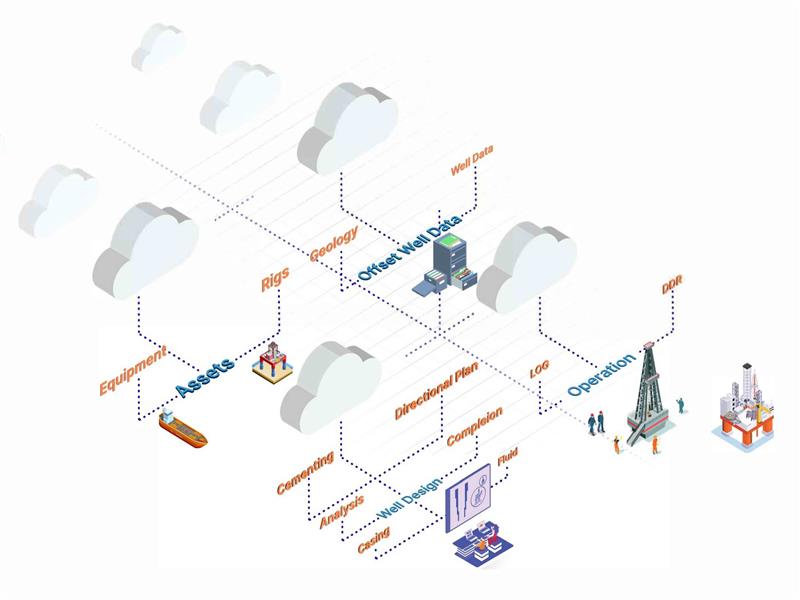
A drilling organization may have valuable information distributed across:
- WITSML streams
- Rig sensors
- Daily Drilling Reports (DDRs)
- Well planning applications
- Engineering databases
- Excel spreadsheets
- Historical well records
- LWD/MWD data
- Mud logging systems
- Operational reports
- Equipment and maintenance records
When these sources remain isolated, engineers may have to spend considerable time collecting, validating, reconciling, and interpreting information before they can even begin the analysis.
This is why modern drilling digitalization should not be viewed simply as an "AI project."
It is a data-to-decision project.
A reliable digital workflow starts with collecting and organizing the right data, establishing consistent data structures, ensuring data quality, and making information accessible in the operational context where decisions are made.
Only then can advanced analytics and AI deliver their full potential.
AI in Real-Time Drilling Operations
The value of AI becomes particularly significant when it moves beyond historical analysis and becomes part of the real-time drilling workflow.
Traditional analysis often answers questions such as:
- What happened during the last well?
- A more advanced data-driven workflow can help answer:
- What is happening now?
- And increasingly:
- What is likely to happen next?
This shift from descriptive to predictive and prescriptive analytics is one of the most important developments in drilling digitalization.
Real-time drilling data can be continuously evaluated against historical patterns, engineering parameters, offset wells, and predefined operational conditions.
For example, a combination of torque, drag, ROP, WOB, RPM, vibration, pressure, and other drilling parameters may contain early indications of an emerging operational problem.
The objective of an intelligent system is not necessarily to make the decision automatically. In many cases, its greatest value is to surface the relevant signal early enough for an experienced engineer to investigate and act.
Recent industry developments demonstrate that this transition is already taking place. In August 2026, ADNOC announced the deployment of an AI-enabled Real-Time Operations Center across more than 120 drilling rigs, with the system designed to provide real-time operational visibility, AI-powered performance insights, and earlier identification of potential issues.
The Human Element Remains Critical
AI should not be considered a replacement for engineering expertise.
Drilling remains a complex physical operation affected by geology, equipment, fluids, well design, formation behavior, operational constraints, and human decisions.
An AI model can identify a pattern, estimate a probability, or highlight an anomaly. An experienced drilling professional must still understand the operational context and determine what action, if any, is appropriate.
This makes Human-AI collaboration particularly important.
The most useful systems are therefore not necessarily those that attempt to automate every decision. They are systems that allow engineers and operational teams to access the right information, understand the underlying evidence, compare alternatives, and respond faster.
Developing the Skills to Work with AI-Driven Drilling
Technology alone does not create a data-driven drilling organization.
Engineers and drilling professionals also need to understand how operational data is collected, structured, analyzed, and used by modern AI systems.
This requires a combination of traditional drilling knowledge and new digital competencies.
Professionals working in this area increasingly need to understand concepts such as:
- Drilling performance optimization
- Data quality and data management
- Real-time data monitoring
- Machine learning fundamentals
- Predictive analytics
- Digital twins
- Data-driven NPT analysis
- AI-assisted decision-making
- Data governance and cybersecurity
This intersection between drilling engineering and digital technology is becoming an important area of professional development.
For professionals interested in developing these capabilities, NAFTA's Drilling Optimization using Data Management & AI training addresses the subject from an operational perspective. The five-day program covers drilling optimization, drilling data management, WITSML, data preparation, machine learning applications, real-time monitoring, predictive maintenance, digital twins, and AI-supported drilling workflows.
The emphasis is not simply on understanding AI concepts, but on understanding how data and AI can be incorporated into actual drilling workflows and engineering decisions.
What Comes After AI Adoption?
The next stage of digital transformation in drilling is unlikely to be defined by simply having more AI models.
Instead, the focus will increasingly be on how effectively organizations can connect their existing data, engineering applications, operational systems, and AI capabilities into a coherent workflow.
A drilling engineer should not have to search through multiple disconnected systems simply to reconstruct the history of a well or understand what is happening on a rig.
The direction of modern drilling technology is toward creating a connected operational environment in which planning data, real-time information, reports, historical records, and analytical insights can be accessed in context.
This approach also makes AI more practical.
Rather than treating AI as a separate application, it becomes another layer of intelligence operating on top of a reliable and connected data foundation.
Building the Foundation for Intelligent Drilling
This is where modern drilling data platforms are beginning to play an important role.
A useful platform does not necessarily require an organization to replace all of its existing engineering software and databases. Instead, it can connect information from different sources and provide a common operational context.
For example, modern platforms can bring together well planning information, WITSML data, daily reports, spreadsheets, databases, and other operational records while maintaining the existing systems that teams already use.
Once this information is properly structured and accessible, it becomes much easier to apply analytics and AI at scale.
This principle is reflected in a growing class of drilling intelligence platforms, including DrillQ, which focuses on connecting fragmented drilling data from well planning systems, WITSML, reports, spreadsheets, databases, and operational records into a unified data environment. Its architecture is designed to work alongside existing tools rather than requiring organizations to replace them, while providing a structured foundation for analytics and AI applications.
The significance of this approach goes beyond software.
It represents a shift from simply collecting drilling data to creating an environment where that data can continuously support engineering decisions.
The Future: From Digital Drilling to Intelligent Drilling
The evolution can be viewed as a progression:
- Data Collection
- Data Management
- Analytics
- AI
- Predictive Intelligence
- Decision Support
- Increasingly Autonomous Operations
Not every organization will move through these stages at the same speed, and not every drilling decision should be automated.
However, the direction is clear.
The competitive advantage will increasingly come not from how much data an organization possesses, but from how quickly and reliably it can transform that data into useful operational intelligence.
AI is therefore not simply another technology added to drilling operations.
Its greater significance lies in its ability to connect data, engineering knowledge, historical experience, and real-time operational information in ways that can help teams identify problems earlier, understand performance more clearly, and make better-informed decisions.
For drilling organizations, the question is gradually changing from:
"Should we use AI?"
to:
"Is our data, technology, and workforce ready to use AI effectively?"
That is ultimately the foundation of intelligent drilling.
Learn More
To explore the professional training perspective on drilling optimization, data management, and AI:
Drilling Optimization using Data Management & AI – NAFTA
For information on drilling data integration and intelligent drilling workflows:
DrillQ – Drilling Data Integration & Intelligence Platform


